
Slopaganda? what fresh hell is this?
and World Press Freedom Hero Awards

Hi there,
I’ll be in Vienna this week, attending the International Press Institute’s World Congress and Media Innovation Festival. I’m really excited for this event for several reasons. One is that I’ll be speaking about Sifter, and the community we have built over the past few years (coming to three at the end of this year 🥳!).
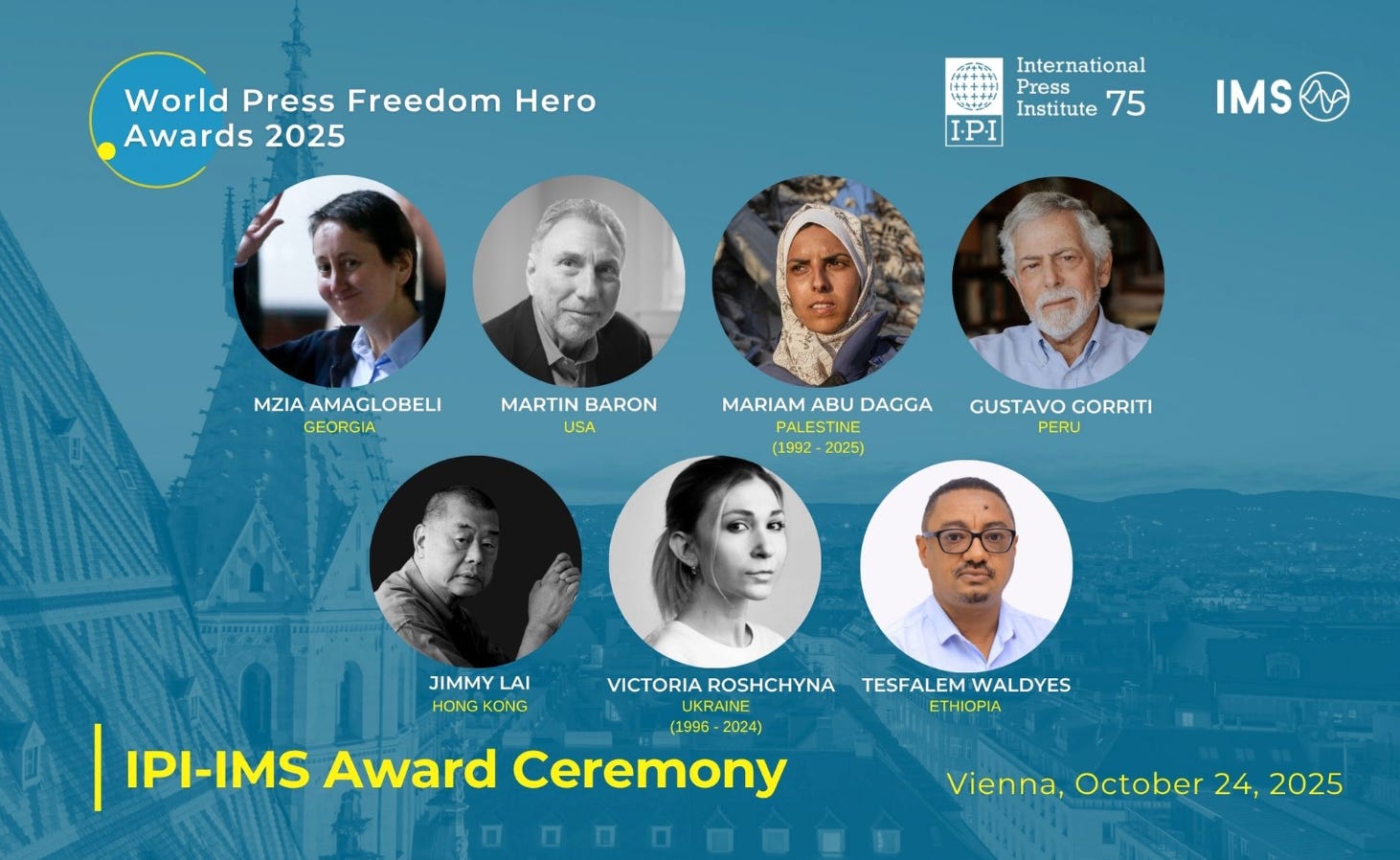
But more importantly, I’ll be there in person to see Ethiopian journalist Tesfalem Waldyes receive this year’s World Press Freedom Hero Award. I wrote about him earlier in June when he was detained for a week.
This year, the award honors seven recipients, including two women journalists honored posthumously: Mariam Abu Dagga from Palestine and Victoria Roshchyna from Ukraine. The award is dedicated to those who “embody the spirit of fearless journalism and the enduring fight for free expression”.
If you are planning to attend this event, reply to this email and let me know!
My name is Maya Misikir, and I’m a freelance reporter based in Addis Abeba. I write Sifter, this newsletter where I send out the week’s top 5 human rights stories in Ethiopia.
Now, to the news.
Infrastructure: physical and digital
I first wrote about Ethiopia’s desire for access to the sea when it was making rounds in the news cycle back in October 2023.
In January 2024, news of a port agreement with Somaliland tanked Ethiopia’s relationship with Somalia and kept the Horn on its toes for a solid year. The port deal may not have materialized, but ‘its tactical purpose’ had already been accomplished: a new narrative that no longer questions whether Ethiopia should have access to the sea, but rather how.
We now have a new player in Ethiopia’s quest for access to the sea: synthetic propaganda or slopaganda.
What’s that? Here’s an excerpt from a post by researchers Amanuel Tesfaye and Matti Pohjonen:
AI-generated propaganda, sometimes referred to as “synthetic propaganda” or “slopaganda,” involves the use of generative AI tools to create synthetic images, audio, and video for circulation on social media platforms such as TikTok, Instagram, YouTube, X, and Facebook.
What kind of messaging do they have?
Narratives that seek to justify and legitimize Ethiopia’s aspirations to reclaim its lost sea access.
Some of them say “from GERD to Assab” referring to the recently inaugurated Grand Ethiopian Renaissance Dam; riding on the ‘support for the GERD to rally society to pursue the port agenda next.’
Why would this kind of slopaganda work over here? Here’s the icing on the cake:
The country’s landlockedness and the manner in which Ethiopia lost its seacoast are perhaps among the few political issues that unite an otherwise fragmented polity.
The full post, here.
To better understand the complex geopolitical actors involved in the Red Sea, I highly recommend reading: “Ethiopia’s Red Sea Politics: Corridors, ports and security in the Horn of Africa”.
Security: we don’t know her (L)
This is the 50th part of a series of updates on security in Ethiopia’s Amhara region. Last week, I wrote about intense fighting that took place in the region’s North Wollo Zone. The International Committee of the Red Cross had reported a ‘large number of casualties, captured fighters and other severe humanitarian consequences’.
The region’s informal militia, the Fano (which has been fighting the federal army since August 2023), has now ‘reportedly taken control of multiple areas’ in this Zone.
Here’s an excerpt from Addis Standard:
A resident of Checheho town, situated at the junction of South Gondar and North Wollo zones, said Fano fighters now control “Checheho, Zebit, Geregera, and Aflakit, including the surrounding areas.”
The Ethiopian National Defense Forces have their own take on the matter, saying that ‘several members of the group, along with weapons and equipment, have been captured.’
The full story, which has a third and contradictory statement from civilians in the areas, here.
The full list of updates on the region, here.
Budget: excluded new regions
Regions in Ethiopia, including South Ethiopia, Central Ethiopia, and South West Ethiopia, have been excluded from the federal budget subsidy allocations.
How does the federal budget subsidy allocation work here?
Here’s an excerpt from The Reporter:
Regional administrations receive federal subsidies each year based on a budget-sharing formula devised by the House [of Federation] six years ago.
The formula takes into account population, need, and revenue generating capacity.
Members of the House are asking why these (newly formed) regional states are not getting any support, despite being constitutionally recognized.
The justification for this oversight? Lack of updated population data, without which budgeting may cause ‘uneven and unfair development among regions’.
In December 2023, I wrote an update when several towns and cities in Central Ethiopia region came to a standstill because of serious budget shortages.
The full story on The Reporter, here.
Poverty: worse before it gets better
Poverty in Ethiopia is expected to ‘increase to 43% by 2025, up from 33%’ according to the World Bank.
The culprits behind this latest bad news include the ‘COVID-19 pandemic, the Tigray conflict, severe droughts, a slowdown in GDP growth, and soaring inflation’ according to a story on Addis Standard.
Here’s an excerpt:
By 2021, 86 percent of rural adults had not completed primary education, nearly half of rural households had at least one stunted child, and over a quarter reported having a severely stunted child, according to the report.
The full story, on Addis Standard, here.
Human rights: transitional justice won’t work here
Ethiopia’s transitional justice policy (a mechanism to deal with the injustices of the country’s past) is not going to work in the case of the Tigray war, says a new report by the Commission of Inquiry on Tigray Genocide.
Why not? Here’s a believable reason:
…the process is fundamentally compromised by political interference and by the fact that the federal government, whose security forces are among the accused, retains control of the design and implementation of justice mechanisms.
What else?
The Commission argues that the framework does not comply with international standards, and criticizes the dialogue’s architects for failing to apply a victim-centered approach, lacking gender sensitivity, and operating without public trust and inclusiveness.
The full story, which has details on the Commission’s report, entitled, ‘War-Induced Genocidal Sexual and Gender-Based Violence in Tigray’, on The Reporter, here.
Was this forwarded to you by someone? Then hit the button below to subscribe and get free weekly updates on Ethiopia.